Development banks play a vital role in shaping India’s economic growth, industrial expansion, and infrastructure development. Unlike commercial banks, which focus mainly on deposits and loans for individuals and businesses, development banks are specialised financial institutions that provide long-term capital for sectors crucial to national development. These banks support industrialisation, rural development, agriculture, exports, and infrastructure—areas that require patient capital and strategic guidance.
In India, development banking gained momentum after Independence, when the need for planned economic development and strong financial institutions became essential. Over the decades, various development banks have been established to meet the financial needs of different sectors and regions.
What Are Development Banks?
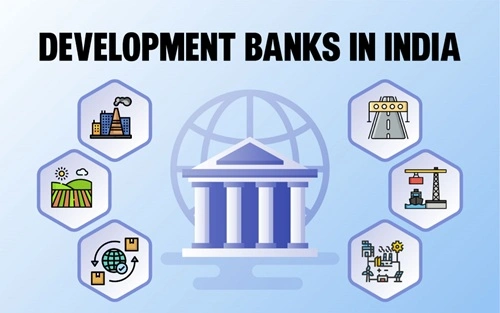
Development banks are financial institutions that provide medium and long-term financing to industries, agriculture, and infrastructure projects. Their goal is not just profit but national development. They support projects with long gestation periods, offer refinancing schemes, help upgrade technology, provide advisory services, and promote entrepreneurship.
Types of Development Banks in India
India’s development banks are broadly categorised based on the sectors they serve:
1. Industrial Development Banks
These banks finance industries, manufacturing units, startups, and technology-driven projects.
- IDBI (Industrial Development Bank of India) – Initially created as a wholly-owned institution of RBI in 1964, IDBI supported industrial growth through long-term finance and project assistance. It later became a commercial bank but continues major development functions.
- IFCI (Industrial Finance Corporation of India) – Established in 1948, IFCI is India’s oldest development bank, supporting industrial and infrastructure projects.
- SIDBI (Small Industries Development Bank of India) – Established in 1990, SIDBI supports MSMEs through loans, refinancing, credit guarantees, and technology programmes.
2. Agricultural and Rural Development Banks
These institutions focus on agriculture, rural industries, and village-level development.
- NABARD (National Bank for Agriculture and Rural Development) – Formed in 1982, NABARD is the apex development bank for agriculture and rural sectors. It finances cooperative banks, regional rural banks, and rural infrastructure projects.
- State Cooperative Agricultural and Rural Development Banks (SCARDBs) – Provide long-term loans for agriculture, dairy, fisheries, and farm mechanisation.
3. Export-Import Development Banks
These banks promote India’s international trade.
- EXIM Bank (Export-Import Bank of India) – Established in 1982, EXIM Bank provides financial assistance to exporters, importers, and overseas investment projects. It also supports credit lines to foreign governments and financial institutions.
4. Infrastructure Development Banks
These banks support large-scale infrastructure projects like highways, airports, power plants, and communication networks.
- IIFCL (India Infrastructure Finance Company Ltd.) – Provides long-term finance for public-private partnership (PPP) infrastructure projects.
- NIIF (National Investment and Infrastructure Fund) – A government-backed fund that invests in energy, transport, and other strategic infrastructure projects.
5. Housing Development Banks
These institutions provide finance for housing construction and development.
- NHB (National Housing Bank) – Established in 1988, NHB promotes housing finance institutions and supports affordable housing projects across India.
Structure of Development Banks in India
The development banking structure in India operates at three major levels:
1. Apex Institutions
These are national-level banks that oversee sectoral development and offer refinancing to state-level institutions.
Examples:
- NABARD
- SIDBI
- NHB
- EXIM Bank
2. State-Level Financial Institutions
These banks operate at the state level and support regional industries and agricultural development.
Examples: SCARDBs and State Financial Corporations (SFCs)
3. Specialised Development Financial Institutions (DFIs)
These institutions finance specific sectors such as infrastructure, small-scale industries, and exports.
Examples: IIFCL, IFCI, NIIF
This three-tier structure ensures balanced financial support across national, state, and sectoral levels.
Functions of Development Banks in India
Development banks perform several crucial functions that contribute to India’s economic progress:
1. Providing Long-Term Finance
They offer medium- and long-term loans for industries, infrastructure, agriculture, and exports—areas where commercial banks hesitate due to long gestation periods.
2. Promoting Industrial Growth
These banks support new industries, MSMEs, technology upgrades, and industrial modernisation. SIDBI and IFCI have been instrumental in promoting small and medium enterprises.
3. Supporting Rural and Agricultural Development
NABARD finances rural infrastructure, irrigation projects, dairy development, cooperative banks, and rural entrepreneurship.
4. Facilitating International Trade
EXIM Bank provides export credit, guarantees, financing for overseas investments, and promotes India’s global trade competitiveness.
5. Funding Infrastructure Projects
Large infrastructure projects require heavy capital investment and long repayment periods. IIFCL and NIIF play a major role in financing highways, metro networks, seaports, airports, and power projects.
6. Encouraging Entrepreneurship
Development banks offer training, technical assistance, and advisory services to boost entrepreneurship and innovation.
7. Refinancing and Support to Financial Institutions
Apex development banks refinance loans given by regional banks, cooperative banks, and microfinance institutions to ensure credit flow at grassroots levels.
8. Policy Formulation and Research
These banks collaborate with the government, conduct research, create development strategies, and support policy making.
Conclusion
Development banks are the backbone of India’s long-term economic planning and strategic growth. From industrialisation to rural empowerment, export promotion to infrastructure creation, these institutions play a transformative role. As India moves towards becoming a $5-trillion economy, the significance of development banks will continue to grow, ensuring financial inclusion, innovation, and sustainable national development.