If you started your business as an LLP, you likely made a smart early decision – lower compliance, no mandatory audit below thresholds, and enough flexibility to figure things out as you grew. But many LLP founders eventually reach a point where the structure starts working against them: an investor wants equity shares, a co-founder wants an ESOP pool, or a larger client insists on dealing with a “company” rather than a partnership.
This is where company registration becomes essential knowledge for LLP founders – not as a completely new concept, but as the next stage of your business’s legal journey. Whether you’re planning a fresh Private Limited Company registration alongside your LLP or a formal conversion under Section 366 of the Companies Act, 2013, the essentials are the same: understand the process, the paperwork, and the compliance shift before you commit.
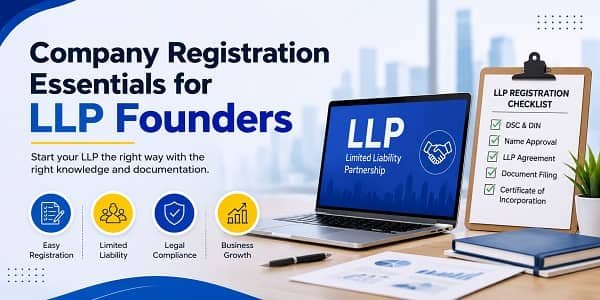
Why LLP Founders Consider Company Registration
Company registration becomes essential for LLP founders when the business needs to raise equity funding, issue ESOPs, or onboard institutional investors – none of which an LLP structure permits, since LLPs cannot issue shares. A Private Limited Company, by contrast, is built for exactly this kind of growth: it can issue shares, create employee stock option pools, and offer investors board representation.
Did You Know? Although LLP registration is regulated by the Ministry of Corporate Affairs and offers limited liability protection, an LLP fundamentally cannot issue equity shares — which is precisely why most institutional investors require a company structure before funding a business.
The Three Common Triggers
- Fundraising – Angel investors and VCs almost always require equity shares and board seats.
- ESOP Plans – Only companies can legally issue Employee Stock Ownership Plans to attract and retain talent.
- Credibility with Larger Clients – Some enterprise clients and government tenders prefer contracting with registered companies over LLPs.
Two Paths: Fresh Registration vs Formal Conversion
LLP founders generally have two options, and choosing the right one depends on whether the existing LLP’s assets, contracts, and history need to carry forward.
| Path | Best For | Key Feature |
| Fresh Private Limited Company Registration | Founders starting an entirely new venture or vertical | New PAN, TAN, and CIN; no continuity with the LLP |
| Formal Conversion (Section 366) | Founders who want to continue the same business, contracts, and history | LLP’s assets, liabilities, and employees automatically transfer to the new company |
Step-by-Step: Converting an LLP into a Private Limited Company
| Step | Action | Typical Timeline |
| 1 | Pass a resolution among LLP partners approving the conversion | 1–2 days |
| 2 | Obtain No Objection Certificate (NOC) from creditors, if any | 3–5 working days |
| 3 | Apply for name reservation via SPICe+ Part A | 1–2 working days |
| 4 | File Form URC-1 along with the list of partners, assets, and liabilities | 5–7 working days |
| 5 | File SPICe+ Part B with MOA, AOA, and AGILE-PRO-S | 5–7 working days |
| 6 | Receive Certificate of Incorporation; the company is now a separate legal entity from the erstwhile LLP | 7–10 working days |
| 7 | Intimate the Registrar of Firms/LLP Registrar about the conversion | Within 15 days of incorporation |
| 8 | File INC-20A (Commencement of Business), since the company will have share capital | Within 180 days of incorporation |
Total conversion timeline typically runs 4–6 weeks, factoring in NOC collection and document preparation, which is usually the slowest step.
Documents Required for LLP-to-Company Conversion
- ✔ LLP Agreement and Certificate of Incorporation of the existing LLP
- ✔ List of all partners with their consent to become shareholders/directors
- ✔ Statement of assets and liabilities of the LLP, certified by a practicing Chartered Accountant
- ✔ NOC from all secured creditors, if applicable
- ✔ PAN and Aadhaar of all partners becoming directors/shareholders
- ✔ Proof of registered office
- ✔ Digital Signature Certificates for proposed directors
- ✔ Copy of the latest income tax return filed by the LLP
What Changes: LLP Compliance vs Company Compliance
| Compliance Area | As an LLP | As a Company (Post-Conversion) |
| Governing Law | LLP Act, 2008 | Companies Act, 2013 |
| Annual Filings | Form 11, Form 8 | AOC-4, MGT-7 |
| Audit Requirement | <cite index=”21-1″>Only above ₹25 lakh contribution or ₹40 lakh turnover</cite> | Mandatory, regardless of turnover |
| Board Meetings | Not mandated by law | Minimum 4 per year |
| Ownership Transfer | Requires LLP Agreement amendment | Simple share transfer |
| Ability to Raise Equity | Not permitted | Fully permitted |
| ESOP Issuance | Not permitted | Permitted under Companies Act |
This shift is the single most important thing LLP founders underestimate – moving to a company means committing to a materially higher, non-negotiable compliance calendar from the very next financial year.
Cost of Conversion in 2026
Setting up the new Private Limited Company structure through SPICe+ costs Rs 7,000-25,000 all-inclusive for a standard two-director company with authorised capital between Rs 1-10 lakh, with the SPICe+ filing itself free for capital up to Rs 15 lakh.</cite> On top of this, LLP founders should budget for:
- CA certification of the LLP’s assets and liabilities statement
- NOC collection fees, if the LLP has secured creditors
- Stamp duty on the new company’s incorporation documents
- Professional fees for managing the dual-filing process (LLP closure intimation + company incorporation)
Note: Unlike registering a company from scratch, conversion involves parallel documentation – you are simultaneously winding down LLP compliance and starting company compliance, which typically increases professional fees by 20–30% over a standard fresh incorporation.
Common Mistakes LLP Founders Make While Converting
- Delaying the decision until a term sheet deadline – conversion takes 4–6 weeks, and rushing it under investor pressure often leads to filing errors.
- Forgetting to obtain NOCs from secured creditors, which stalls the URC-1 filing indefinitely.
- Assuming all LLP partners automatically become directors – partners must explicitly consent to become shareholders and, separately, to become directors.
- Not planning for the new audit requirement, which becomes mandatory the moment the entity becomes a company, regardless of turnover.
- Ignoring existing LLP contracts that may need consent from counterparties before they can transfer to the new company.
- Missing the 15-day intimation window to the LLP Registrar after incorporation, which can attract additional compliance scrutiny.
Case Study
A three-partner fintech LLP in Hyderabad had grown steadily for two years, staying comfortably under the audit threshold. When a Series A investor offered funding contingent on receiving preference shares and a board seat, the founders initiated conversion under Section 366. The process took five weeks – largely due to delays in obtaining NOCs from two working capital lenders. Once converted, the founders were surprised by the immediate requirement for quarterly board meetings and a mandatory statutory audit, both of which they had not budgeted for in their first-year operating costs. Their key takeaway: plan the compliance shift, not just the funding round.
Conclusion
For LLP founders, understanding company registration essentials isn’t about abandoning what worked – it’s about recognising when your business has outgrown the LLP structure’s limitations. Whether through fresh incorporation or a formal Section 366 conversion, moving to a Private Limited Company opens the door to equity fundraising, ESOPs, and greater institutional credibility, but it also brings a permanently higher compliance load. The founders who navigate this transition smoothly are the ones who plan the conversion timeline, budget for new compliance costs, and secure creditor NOCs well before a funding deadline forces their hand.
Why Choose Zolvit
- Expert lawyers, CAs, and Company Secretaries to manage your LLP-to-company conversion end to end
- Fast, accurate SPICe+ and URC-1 filing to avoid rejection delays
- Affordable, transparent pricing with no hidden professional fees
- End-to-end compliance transition support, from LLP closure intimation to your first board meeting
- Dedicated support throughout the conversion and beyond
FAQs
Q: Can an LLP directly convert into a Private Limited Company?
A: YES. An LLP can convert into a Private Limited Company under Section 366 of the Companies Act, 2013, using Form URC-1 alongside SPICe+ Part B, with all assets and liabilities transferring automatically to the new company.
Q: Should all LLP partners become directors of the new company?
A: Partners must explicitly consent to become shareholders and, separately, to become directors. Not every partner necessarily takes on a director role after conversion.
Q: Is a fresh PAN and TAN required after conversion?
A: YES. The converted company receives a new Certificate of Incorporation, PAN, and TAN, as it becomes a distinct legal entity from the erstwhile LLP, despite the continuity of assets and liabilities.
Q: Can the converted company retain the LLP’s existing contracts?
A: YES, generally. Contracts transfer to the new company under Section 366, though counterparties may need to provide consent for certain agreements, especially loan or lease contracts.
Q: Shall a statutory audit become mandatory immediately after conversion?
A: YES. Once the entity becomes a company, statutory audit is mandatory from the very first financial year, regardless of turnover, unlike the threshold-based audit requirement under LLP rules.